SaxevaSaxeva
A virtual saxophone for MIDI wind controllers

Every saxophone, one breath.

Saxeva turns your wind controller into real saxophones: each horn is built from 32 recorded notes in 3 dynamic layers, with real vibrato, tonguing and legato. However you breathe, the tone and dynamics follow.

Coming soon on theApp Store See what it does

iPhone, iPad and Mac · Vietnamese and English · Needs a MIDI wind controller (Clarii, EWI…)

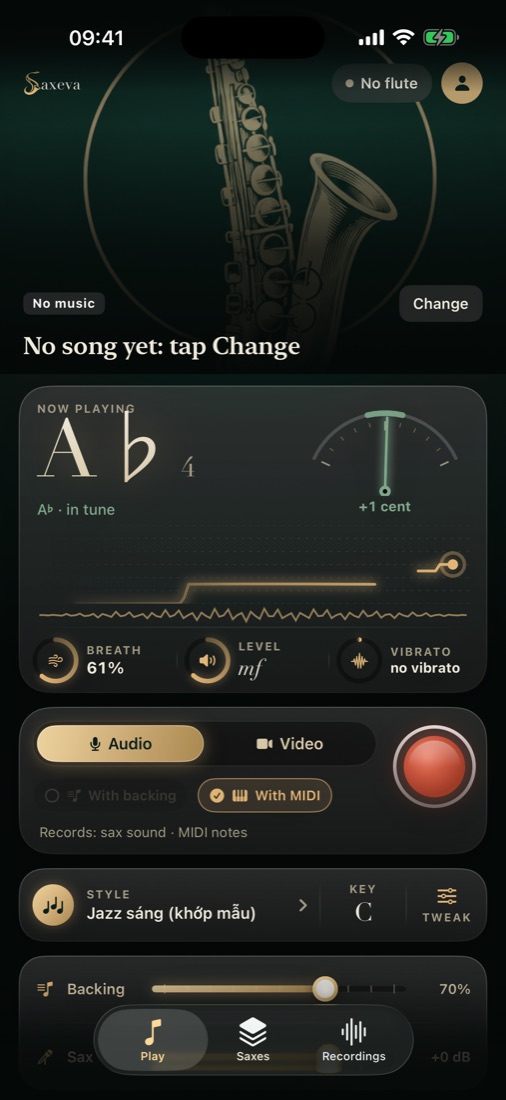
Saxeva's Play screen
Four horns

From sweet soprano to deep baritone.

Each horn is built from recordings of a real saxophone, with its own range and voice. Switch with one tap.

Soprano saxophone

Soprano

B♭

Bright, sweet, soaring.

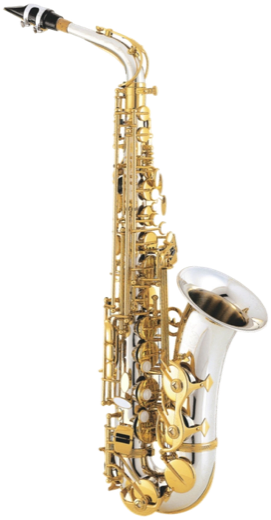
Alto saxophone

Alto

E♭

Warm, round, singing.

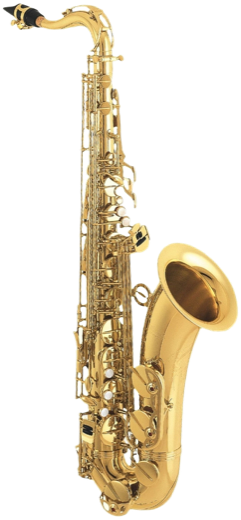
Tenor saxophone

Tenor

B♭

Full, husky, breathy.

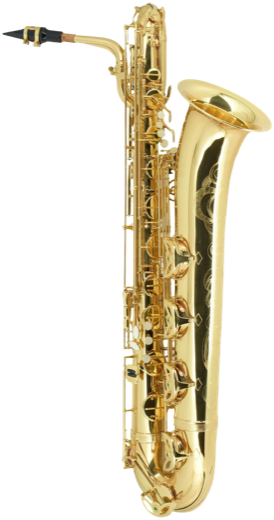
Baritone saxophone

Baritone

E♭

Deep, punchy, powerful.

Features

Your breath. Every sax.

Everything to practise, play and record saxophone from a wind controller, on your phone or your Mac.

Follows every breath

Loudness, tone and vibrato follow exactly how you blow, with low latency.

Many sound styles

Bright jazz, warm ballad, soft reverb… each style shapes brightness, breath, vibrato and room. Save your own.

Record audio and video

Record the sax, film video with its sound, and capture MIDI to replay it through another style.

Play along

Pick a song on YouTube or your own backing track and play with it.

USB or Bluetooth MIDI

Plug in your controller or connect wirelessly; the app finds it.

iPhone and Mac in sync

Sign in with Apple or Google (optional): your setup and styles follow your account.

For players

The real sax is in the details.

What happens between your breath and the horn's sound, with the engine's own numbers.

Three dynamic layers, blended by breath

Every note has pp, mf and ff recordings of the same horn. Breath does not just turn it up: it blends continuously between the three layers, so the tone brightens and gains harmonics as you push, like a real sax. The breath curve (0.4–2.5) adapts to how hard you blow.

Real vibrato, not a sine wave

The pitch and loudness curves of the vibrato come from vibrato notes played on real saxophones, natural wander included. Bite vibrato from the controller follows those curves; auto vibrato runs at 2.5–8 Hz and up to 100 cents peak-to-peak, including the delayed vibrato of pop ballads that blooms after about 0.3 s.

Tonguing and legato

A note after a rest counts as tongued: its attack is brighter than its body (measured on real jazz sax: 0.2–1.7 octaves), with an attack softness of 1–60 ms. Slurred notes cross-fade in 5–150 ms with the air kept continuous and no cut. Releases run 5–400 ms, short like a tongue stop.

Altissimo, scoops, growl, bends

Above written F6, altissimo notes are pitch-shifted from the nearest recorded note. Scoops into the note up to 150 cents, growl near the top of the breath, and ±24-semitone pitch bend from the controller's bend plate or bite.

Where the sax voice sits in the spectrum

Styles shape the very frequency regions the ear hears as saxophone: the body around 800 Hz, the mid formant that makes the "voice", and the buzz around 4.5 kHz typical of jazz and pop sax. Classical is dark and round; jazz is bright and punchy.

A studio inside, one engine everywhere

Reverb computed in-app from small rooms to large halls, plate and cathedral; echo like the Clarii's own effect; album-style compression (up to 8:1) for an even tone and standing tails. Mac and iPhone share one sound engine: a parity test renders 33 phrases on both and compares them sample by sample.

Tuning and transposition

A4 from 415 to 466 Hz to match a record or a band; transposition of ±24 semitones; note names in concert pitch (C) or for the horn (B♭, E♭); the tuner follows the chosen reference.

Connection and latency

Breath arrives as CC2, CC11 or aftertouch; the app tells whether a Clarii is in normal mode (CC2) or MIDI Mode (CC11). The audio buffer is 128 frames, about 2.7 ms at 48 kHz on the Mac. Use wired headphones or the device speaker: Bluetooth adds noticeable delay.

Range and transposition
HornKeyWritten rangeConcert rangeRecorded notesDynamicsSample rate
SopranoB♭B♭3–F6A♭3–E♭632pp · mf · ff44.1 kHz
AltoE♭B♭3–F6D♭3–A♭532pp · mf · ff44.1 kHz
TenorB♭B♭3–F6A♭2–E♭532pp · mf · ff48 kHz
BaritoneE♭B♭3–F6D♭2–A♭432pp · mf · ff44.1 kHz

Written range is what you finger when playing as that horn; concert range is what sounds. Notes above written F6 are altissimo, shifted from the nearest recorded note.
Inside the app

All on one stage.

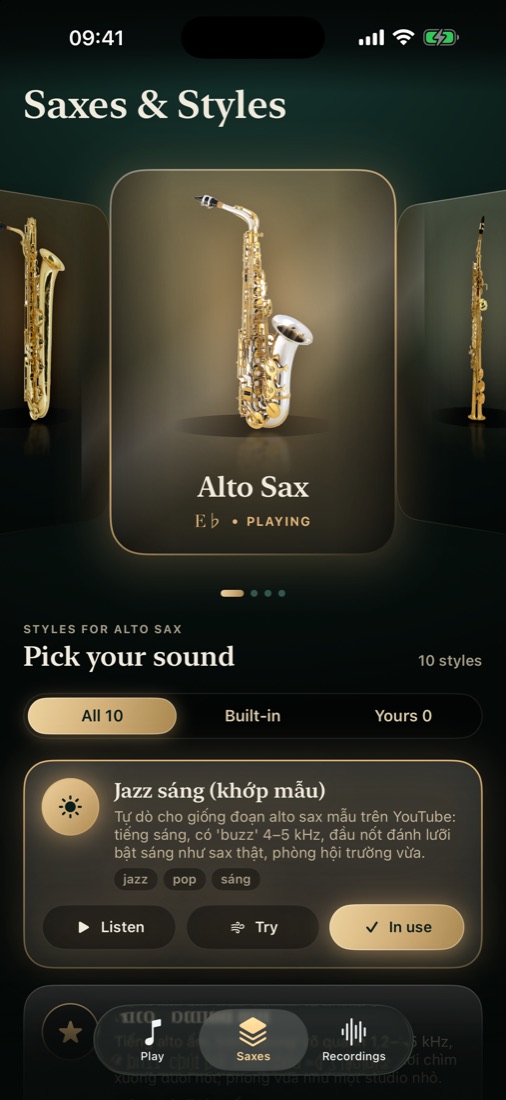
Saxes & styles
Pick a horn and a style
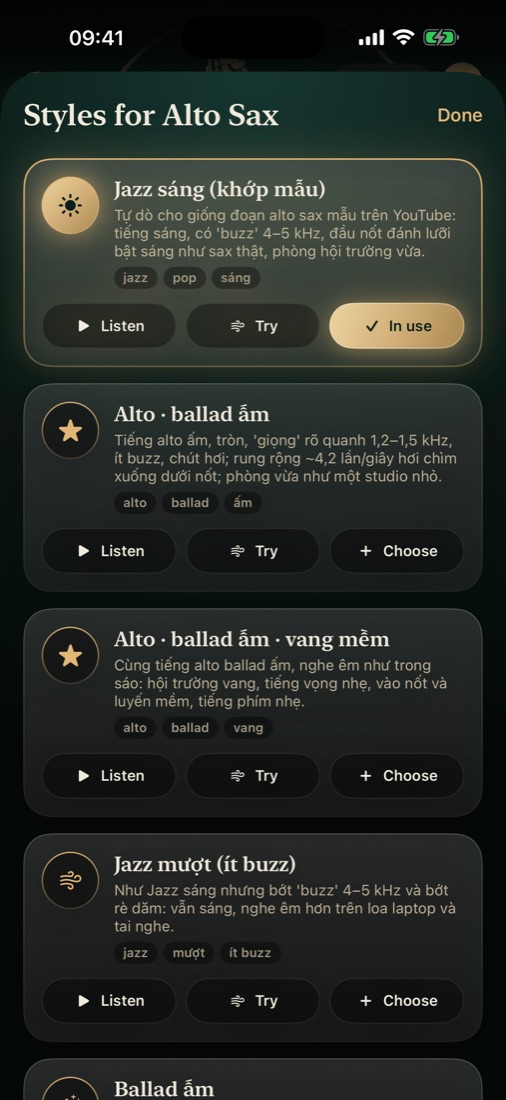
Tune a style
Shape the sound
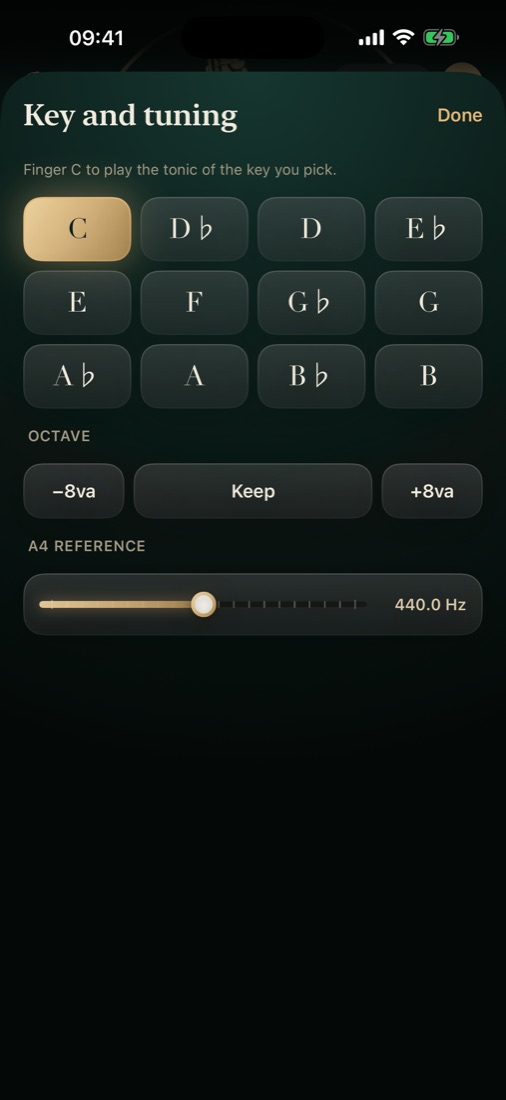
Key
Change key in one tap
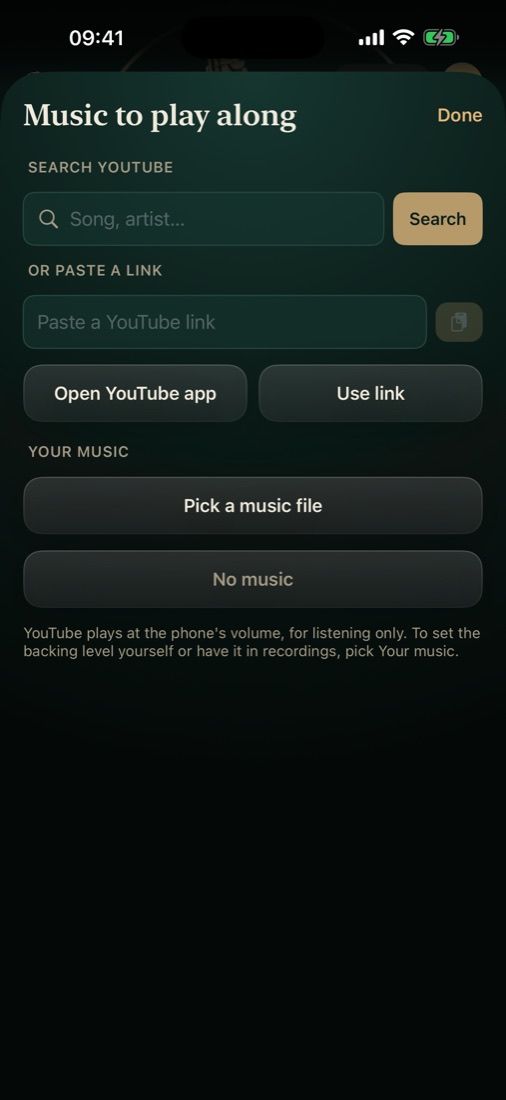
Backing music
Play along with music
Recordings
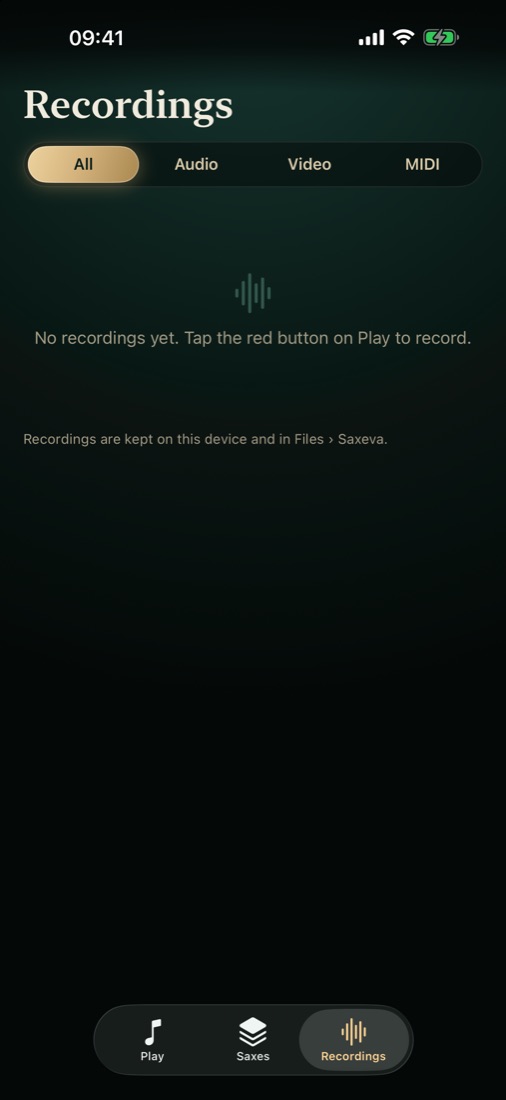
Listen back
Getting started

Three steps to play.

Connect your controller

Plug in over USB or turn on Bluetooth MIDI. MIDI mode on the controller works best.

Pick a horn and a style

Soprano, alto, tenor or baritone, then the sound that suits the song.

Play and record

Play along, record audio or video, then listen back.

Listen & compare

Next to a real sax, with real numbers.

For each horn: an openly licensed recording of a real saxophone, and Saxeva playing exactly that phrase (transcribed into controller data and played back), at the same loudness. The similarity score is measured by software across 8 sound aspects, on a 0–100 scale, averaged over 5 renders.

Soprano B♭

Reference recording: University of Iowa MIS: soprano, vibrato, mf · Iowa MIS (free to use)

Real saxUniversity of Iowa MIS: soprano, vibrato, mf
SaxevaStyle Classical · 72/100
SaxevaStyle Smooth jazz · 54/100
Similarity to the real Soprano recording (0–100)
StyleTotal (range)TimbreVibratoAttackBreathRoughnessKey noise
Classical7270–745688889634100
Smooth jazz5451–561677858630100
Sweet pop ballad3130–320648715051

Alto E♭

Reference recording: University of Iowa MIS: alto, vibrato, mf · Iowa MIS (free to use)

Real saxUniversity of Iowa MIS: alto, vibrato, mf
SaxevaStyle Classical · 65/100
SaxevaStyle Smooth jazz · 63/100
Similarity to the real Alto recording (0–100)
StyleTotal (range)TimbreVibratoAttackBreathRoughnessKey noise
Classical6562–66358083699590
Smooth jazz6356–65297683848694
Bright jazz2523–2702046306454

Tenor B♭

Reference recording: VCSL: tenor, vibrato · CC0 1.0

Real saxVCSL: tenor, vibrato
SaxevaStyle Classical · 58/100
SaxevaStyle Jazz · 50/100
Similarity to the real Tenor recording (0–100)
StyleTotal (range)TimbreVibratoAttackBreathRoughnessKey noise
Classical5853–60687938776100
Ballad5144–56974548810080
Jazz5049–52089894078100

Baritone E♭

Reference recording: Karoryfer Bear Sax: baritone, staccato riff · CC0 1.0

Real saxKaroryfer Bear Sax: baritone, staccato riff
SaxevaStyle Classical · 74/100
SaxevaStyle Jazz · 54/100
Similarity to the real Baritone recording (0–100)
StyleTotal (range)TimbreAttackBreathRoughness
Classical7474–7477537588
Jazz5454–54394610080
Funk3737–3725088100
How it is measured

The tool tools/similarity.py compares Saxeva's render with the real recording across 8 weighted aspects: timbre 30% (long-term average spectrum and harmonic envelope), vibrato 15% (rate, depth, wander), attack 12%, legato 12%, breath 8% (harmonic-to-noise ratio), room 8%, roughness 8%, key noise 7%. Aspects that cannot be measured in a phrase are skipped and the weights renormalised. 100 means the measurements cannot tell the two apart. Each score is the mean of 5 renders with 5 random seeds (real vibrato takes and key noises are chosen at random); the Total column also shows the low–high range. The classical styles are the fairest comparison because the reference recordings are classical saxes recorded in a dry room; the jazz, funk and pop ballad styles are deliberately brighter, wetter or vibrate differently, so they score lower against these recordings. Measured on 2026-11-23. Against the very recordings the styles were tuned to (commercial recordings, not playable here for copyright reasons), the alto's Bright jazz style scores 77.8/100 and the tenor's warm ballad style 80.9/100 (same day, same tool).

Key facts

Saxeva at a glance.

Name
Saxeva
Category
Virtual instrument: saxophone for MIDI wind controllers
Platforms
iPhone, iPad (iOS/iPadOS 17+), Mac
Saxophones
Soprano (B♭), alto (E♭), tenor (B♭), baritone (E♭)
Samples per horn
32 real notes × 3 dynamic layers (pp, mf, ff), 44.1–48 kHz
Written range
B♭3–F6; altissimo shifted from the nearest recorded note
Built-in styles
29, plus the styles you save
Connection
USB MIDI, Bluetooth MIDI; breath via CC2, CC11 or aftertouch
Works with
Clarii, EWI and other MIDI wind controllers
Similarity to real sax
58–74/100 (classical style, against real recordings of the same phrase)
Sound sources
Iowa MIS, VCSL, Karoryfer Bear Sax (open licences)
Languages
Vietnamese, English
Price
Free download
Privacy
No ads; recordings never leave your device
Developer
Le Quang
Contact
hello@saxeva.com
FAQ

Quick answers.

What is Saxeva?

Saxeva is a virtual saxophone app for iPhone, iPad and Mac. You blow a MIDI wind controller (such as Clarii or EWI) and Saxeva plays soprano, alto, tenor or baritone sax, built from recordings of real saxophones, following exactly how you breathe.

What do I need to play?

An iPhone or iPad on iOS/iPadOS 17 or later, or a Mac, and a MIDI wind controller that sends notes and breath (CC2, CC11 or aftertouch), connected over USB or Bluetooth MIDI. Without a controller you can still listen with the Demo button.

How close is Saxeva to a real saxophone?

There are real numbers: against recordings of real saxophones playing the same phrase, Saxeva's classical styles score 58–74/100 across 8 sound aspects (timbre, vibrato, attack, breath, roughness, key noise…). The score tables and side-by-side clips are in the Listen & compare section of this page.

Is Saxeva free?

Saxeva is a free download on the App Store.

Do I have to sign in?

No. Every playing and recording feature works without an account. Signing in with Apple or Google only syncs your setup and styles between iPhone and Mac.

Are my recordings uploaded?

No. Audio, video and MIDI captures are stored on your device only. Saxeva has no ads and sells no data.

Where does Saxeva's sound come from?

From openly licensed recordings of real saxophones: University of Iowa MIS (alto, soprano), the Versilian Community Sample Library (tenor, CC0) and Karoryfer Bear Sax (a 1926 Conn baritone, CC0).

Is Saxeva available in English and Vietnamese?

Yes. The app and this website are in Vietnamese and English, with dark and light themes.

Ready to play?

Saxeva is coming soon to the App Store. For help or feedback, write to us.

hello@saxeva.com